
Legal · PRESS RELEASE
ISC Issues Critical Warning: Developing Countries May Open the Door to Organized Crime Networks If They Fail to Revise Their Policies
SHERIDAN, Wyo., November 17, 2026 -- The International Solidarity Council (ISC) today published a five-point policy call to governments and international organizations, urging transparent visa decisions, reasonable processing times, accessible legal migration pathways, stronger cooperation against human smuggling networks, and greater accountability in the migration consultancy sector.…
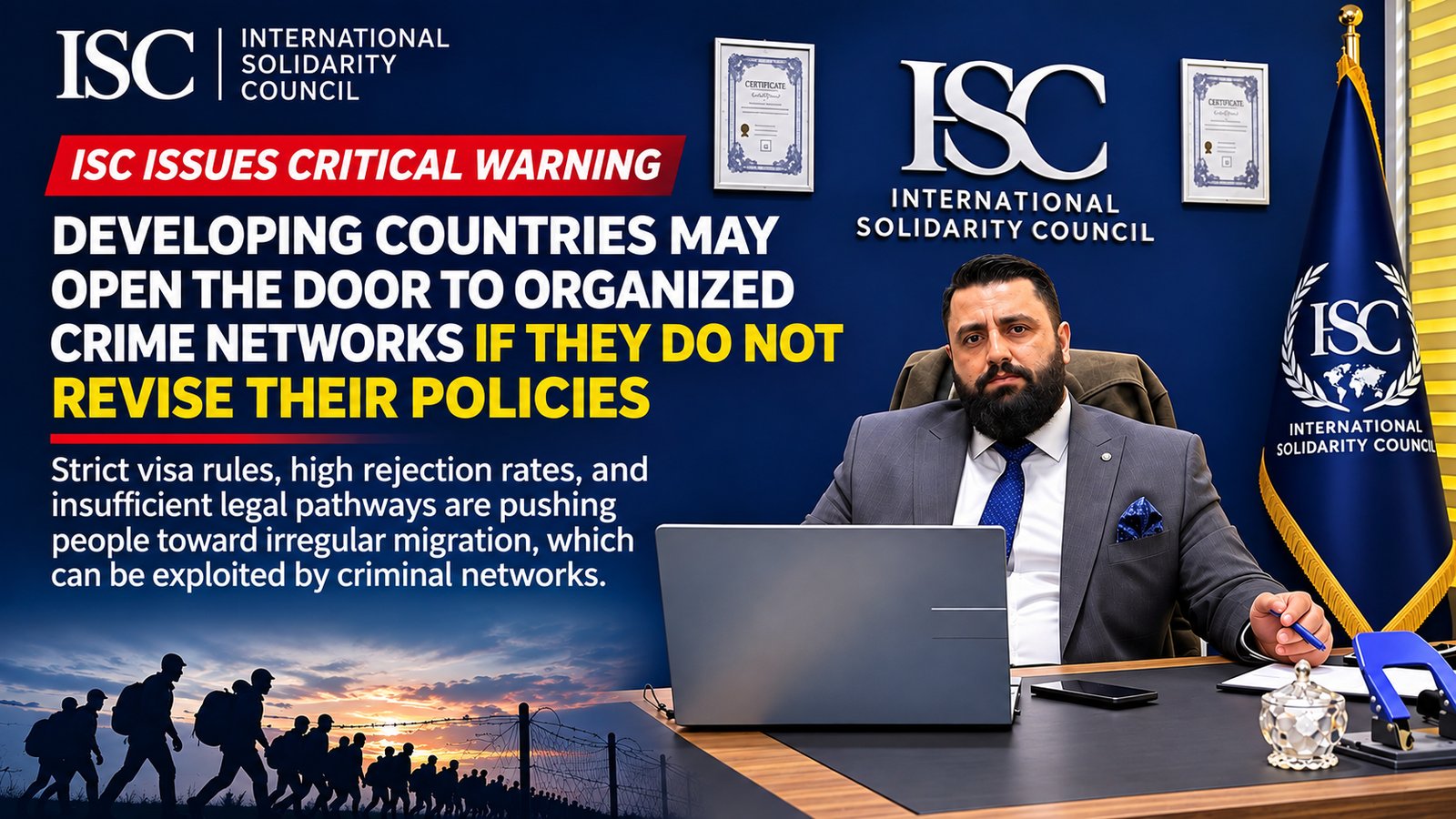
SHERIDAN, Wyo., November 17, 2026 -- The International Solidarity Council (ISC) today published a five-point policy call to governments and international organizations, urging transparent visa decisions, reasonable processing times, accessible legal migration pathways, stronger cooperation against human smuggling networks, and greater accountability in the migration consultancy sector. The call, announced by ISC President Kenan Tekdemir, responds to rising visa rejection rates and long processing times that, according to the Council, can push applicants toward smugglers who promise guaranteed entry. It affects visa applicants in developing countries, the consultants who advise them, and the authorities who set visa policy, and ISC is asking these parties to open an evidence-based dialogue now.
The International Solidarity Council (ISC), a US-registered nonprofit organization dedicated to strengthening professional ethics and promoting safe and lawful international mobility, has issued a warning concerning the potential consequences of increasingly restrictive visa policies and limited legal migration opportunities.
According to the Council, migration policies that rely predominantly on border restrictions and visa refusals may fail to address the underlying reasons why individuals seek to relocate to other countries.
ISC emphasizes that excessive administrative barriers, lengthy visa processing times, high application costs, and limited access to lawful migration channels may contribute to circumstances in which vulnerable individuals consider dangerous and irregular alternatives.
The organization warns that such circumstances can create opportunities for human smuggling networks and other organized criminal groups to exploit individuals seeking international mobility.
"When Someone Is Determined to Migrate, Closing Legal Doors May Not Stop Them"
ISC President Kenan Tekdemir emphasized that migration decisions are often driven by powerful economic, social, and personal circumstances that cannot always be addressed through restrictive immigration policies alone.
"When an individual has firmly decided to leave their country and build a future elsewhere, administrative barriers do not necessarily eliminate that determination.
If people believe that legitimate migration pathways are inaccessible, some may begin searching for alternative routes. Unfortunately, this is precisely where criminal networks may attempt to exploit their circumstances.
Rejecting a visa application does not automatically eliminate a person's intention to migrate. In certain situations, it may simply change the route that person considers taking.
Governments must therefore ask themselves an important question: Are our policies encouraging safe and lawful mobility, or are they unintentionally creating conditions that criminal organizations can exploit?"
Restrictive Visa Policies Do Not Always Produce the Intended Results
The International Solidarity Council recognizes the sovereign right of every country to regulate immigration, establish visa requirements, and protect its national security.
However, the Council believes that immigration systems should also consider the practical consequences of restrictive policies, particularly when legal alternatives remain limited or inaccessible.
For individuals experiencing economic hardship, family separation, insecurity, or limited opportunities in their home countries, the motivation to migrate may remain strong despite increasingly difficult visa procedures.
ISC stresses that visa rejection rates and irregular migration cannot be assumed to have a direct causal relationship in every country or visa category. Nevertheless, the organization calls for further evidence-based research into how restrictions, administrative barriers, and the availability of legal pathways influence migration decisions.
The Council also highlights the need to examine policies in both destination countries and developing countries, particularly where restrictions on international mobility disproportionately affect vulnerable populations.
Organized Crime Networks May Exploit Gaps in Legal Migration Systems
ISC warns that human smuggling organizations frequently seek to exploit people who face uncertainty, lack reliable information, or have limited access to lawful migration opportunities.
Such networks may advertise misleading services, promise guaranteed entry into foreign countries, demand substantial payments, and expose individuals to serious financial, physical, and legal risks.
President Kenan Tekdemir stated:
"No government should assume that increasingly restrictive visa policies will automatically eliminate irregular migration.
As long as the underlying economic, social, and security conditions driving migration remain unresolved, migration pressures may continue.
If governments genuinely wish to weaken criminal smuggling networks, they must examine not only how people cross borders unlawfully, but also why some individuals believe they have no realistic legal alternatives.
It would be inaccurate to suggest that everyone denied a visa will turn to irregular migration. However, the absence of accessible and reliable legal options can increase vulnerability to exploitation."
ISC Calls for Greater Transparency in Visa Decision-Making
The International Solidarity Council is calling for a more balanced approach to international mobility, one that protects national security while improving the transparency, predictability, and accessibility of lawful migration procedures.
The Council recommends five priority areas for international cooperation:
1. Transparent Visa Assessment Procedures
Visa decisions should be based on clear and consistent criteria. Where legally permissible, applicants should receive understandable explanations for refusals and information about available review or appeal procedures.
2. Accessible and Regulated Legal Migration Pathways
Governments should consider expanding appropriate legal pathways for employment, education, family reunification, and other legitimate purposes, while maintaining necessary eligibility and security requirements.
3. Reasonable Processing Times
Immigration authorities should work toward reducing unnecessary administrative delays and prolonged uncertainty for applicants.
4. Stronger Action Against Human Smuggling Networks
International cooperation, information sharing, law enforcement coordination, and public awareness initiatives should be strengthened to prevent criminal organizations from exploiting vulnerable individuals.
5. Professional Ethics and Consumer Protection
Greater transparency and professional accountability are needed among businesses and individuals providing visa, immigration, residency, and citizenship consultancy services.
ISC believes these measures can help reduce opportunities for fraud, misleading promises, and exploitation within the international mobility sector.
"Combating Human Smuggling Is Not Solely a Border Security Issue"
The Council emphasizes that preventing irregular migration and developing safe, orderly, and regular migration pathways should not be treated as mutually exclusive objectives.
ISC believes governments can maintain effective border controls while also adopting practical, rights-respecting policies that reduce the vulnerabilities exploited by organized criminal networks.
President Kenan Tekdemir further stated:
"The world does not need uncontrolled migration. What the world needs is a safe, orderly, transparent, and accountable international mobility system that respects human dignity.
If governments focus exclusively on creating additional barriers without examining how those barriers affect human behavior, they may unintentionally contribute to conditions that criminal organizations can exploit.
Our call is not for the removal of national borders or the abandonment of immigration controls.
Our call is for more effective, transparent, and reliable legal systems that protect both national interests and the individuals who seek legitimate opportunities abroad.
The ultimate objective should be to make lawful migration more trustworthy and criminal exploitation less viable."
A Call for International Dialogue and Policy Reform
The International Solidarity Council calls upon governments, international organizations, policymakers, civil society institutions, and professional associations to examine the broader consequences of visa restrictions and limited legal migration opportunities.
ISC encourages evidence-based dialogue on the relationship between migration policy, visa accessibility, irregular migration, and organized criminal exploitation.
The Council further advocates stronger international cooperation to improve professional standards within the migration consultancy sector, protect applicants from fraudulent practices, and promote safe and lawful international mobility.
ISC maintains that sustainable migration governance requires more than restrictive measures. It requires coordinated policies that address economic pressures, strengthen legitimate migration channels, and reduce opportunities for criminal exploitation.
The organization reiterates its commitment to supporting international dialogue, professional accountability, and practical solutions to the challenges associated with global mobility.